

Featured episode · The CMO Whisperer
Raja Rajamannar on Why Mastercard Stopped Leading With Ads
Mastercard’s longtime CMO on moving one of the world’s most valuable brands from advertising to experiences, why two out of three CEOs doubt their marketers, and how a notch on a card became some of the brand’s best marketing.
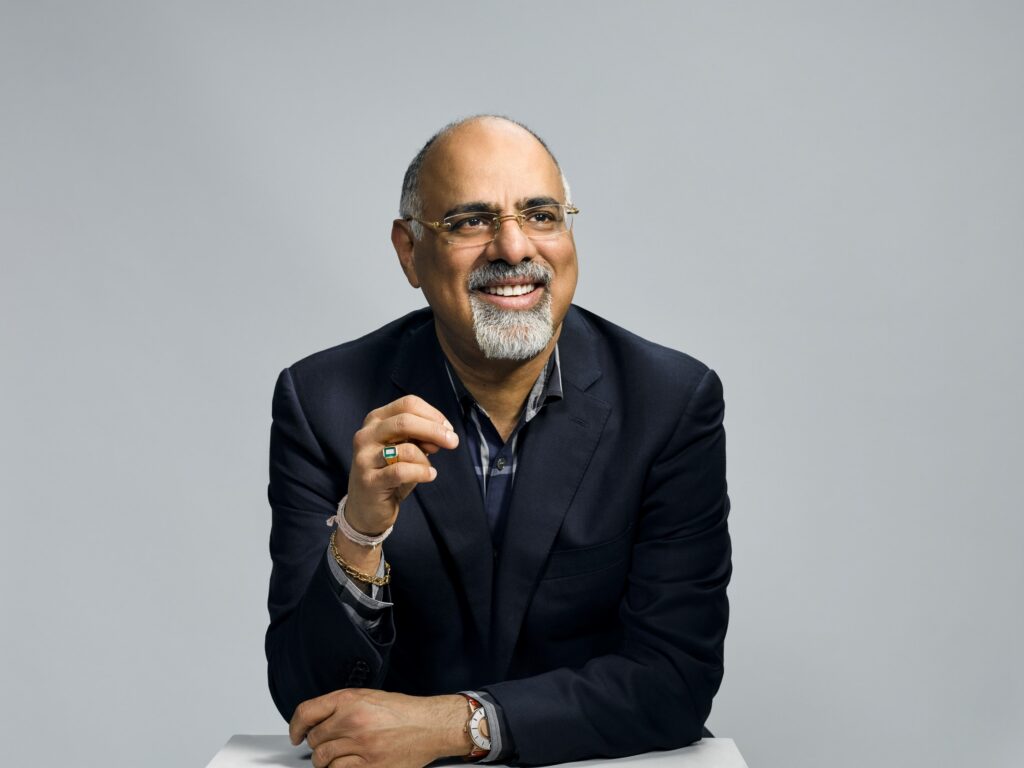
Recorded in January 2024, when Raja led marketing and communications at Mastercard. In December 2025 he handed the role to Jill Kramer and became a senior fellow at the company. Figures are as Raja gave them at the time.
Why this conversation matters
Raja gets into the parts of the job most CMOs keep off stage: why he won’t spend $5 million on 30 seconds, why CFOs tune out when marketers talk about brand lift, and what it took to launch a card no bank wanted to issue.
Under Raja, Mastercard became one of the world’s 10 most valuable brands and was named the number one audio brand four years in a row. Harvard Business School and the Yale School of Management teach his work as case studies, and his book, Quantum Marketing, is a Wall Street Journal bestseller. If you have to defend your budget, your team or your seat at the table, start here.
Steve’s take
I’ve known Raja since my Forbes days, when we’d run into each other at places like the Grammys. What stays with me from this conversation is how simple his answers are: ask the customer, prove the business impact, solve a real problem. We marketers overcomplicate things, and Raja is the cure for that.
Steve Olenski, host of The CMO Whisperer
Five takeaways for marketing leaders
Experiences beat interruptions.
When Raja joined Mastercard in 2013, his working theory was that advertising was getting more expensive and less productive. People see 3,000 to 10,000 messages a day, more than 600 million use ad blockers, and millions pay for ad-free streaming to avoid interruptions. So Mastercard moved from advertising-led to experience-led marketing. It also explains why the brand hasn’t run a Super Bowl ad in about 20 years: the same money buys far more experiences that serve the business.
Marketing has a credibility problem, and marketers created it.
Growth, revenue and customer responsibilities are moving to chief growth, revenue and customer officers. Raja cites surveys in which two out of three CEOs say they don’t trust marketing to drive growth. His diagnosis: when the CEO or CFO asks what a $10 million campaign did for the business, marketers answer with brand perception and funnel metrics. Leadership wants top line, bottom line, profitability and retention.
Build a Leonardo da Vinci team.
Most senior marketers came up on the creative, qualitative side. The performance marketers who arrived with digital brought testing and automation, which Raja calls important but not sufficient. What’s missing is whole-brain marketing: creative judgment plus real comfort with data and technology. If you don’t have both, hire people who cover what you lack.
Use generative AI as a co-pilot, not a replacement.
Mastercard’s “RFP factory” cut the first draft of a response to a bank’s RFP from six or seven weeks to under four hours. Raja uses AI for routine work and first ideas, never as a stand-in for thinking. Agencies will need fewer writers, he says, but the smart ones will use AI to do better work than ever. He practices it himself in a small “Gen AI studio,” a loaded MacBook Pro, and takes lessons every weekend.
Solve a real problem and the product does the marketing.
Raja grew up helping his blind grandmother. Years later, a finance colleague asked him at South by Southwest why there was no card for blind people. The answer was the Touch Card: a notch on the edge tells the holder which way is up, and its shape tells them whether it’s debit, credit or prepaid. It is now in about 30 countries. The True Name card lets transgender customers use their chosen name. No bank would touch it until BMO launched it in Canada. It worked, others followed and it reached 35 countries, despite hate mail at the start.
In Raja’s words
“Advertising is becoming more and more expensive and less and less productive.”On the theory behind Mastercard’s shift to experiences
“If your CEO doesn’t have confidence in marketing driving growth profitably, that’s an issue, which means we are doing something wrong as a marketing community.”On the CMO credibility gap
“It can be a fantastic tool for you. It cannot be a substitute for your thinking or for your creativity.”On generative AI
What this means for CMOs
- Report in business terms. Before your next budget review, restate your three biggest programs in revenue, margin and retention. If you can’t, that’s the gap Raja describes.
- Find the interruptions. List where your brand adds to a customer’s experience and where it only interrupts it. Move money toward the first list.
- Check your team’s balance. Who brings creative judgment, and who brings data and technology? Hire or partner for the side you’re missing.
- Give AI the first draft. Pick one slow, repeatable task, like briefs or RFP responses. Let AI write draft zero and keep people on the thinking.
- Look for a product fix. Some of your best marketing may be a small change that solves a real customer problem.
Frequently asked questions
Why doesn’t Mastercard advertise in the Super Bowl?
Mastercard moved from advertising-led to experience-led marketing when Raja Rajamannar became CMO in 2013. He respects the Super Bowl’s reach, but a 30-second spot costs about $5 million, and that money buys far more experiences that serve Mastercard’s business.
What does Raja Rajamannar think marketers get wrong?
They don’t connect marketing to business results. When CEOs and CFOs ask what a campaign did, marketers answer with brand metrics instead of revenue, profit and retention, and leadership loses confidence in marketing.
How does Mastercard use generative AI in marketing?
To sharpen creative briefs, generate ideas and speed up B2B work. Its “RFP factory” cut the first draft of a response to a bank’s RFP from six or seven weeks to under four hours.
What is the Mastercard Touch Card?
A card with a notch on its edge that helps people who are blind or partially sighted use it by touch. The notch shows which way to hold the card, and its shape shows whether it is a debit, credit or prepaid card.
Who is Raja Rajamannar?
He led marketing and communications at Mastercard from 2013 until December 2025, when he became a senior fellow at the company. He wrote Quantum Marketing and is a member of the Marketing Hall of Fame.
Keep listening
Subscribe to The CMO Whisperer newsletter
New conversations, event invitations and insights from Steve. Unsubscribe anytime.
New conversations every week
Steve Olenski talks with the CMOs and leaders shaping modern marketing. Unscripted and on the record.
